October 2026 English edition · Evidence reviewed through October 3, 2026 · David Shusterman, MD
Appendix K: The Kidney Stone Survival Manual
A kidney stone episode creates two problems at once. The first is physical: pain, nausea, urinary symptoms, and uncertainty about whether the kidney is safely draining. The second is cognitive: severe pain makes it difficult to organize information, follow instructions, and decide when the situation has crossed from miserable to dangerous. This manual is designed to reduce that cognitive burden. It does not replace individualized medical care. It gives the patient and household a disciplined framework for the hours between the first symptom and definitive evaluation.
The First Ten Minutes
When familiar flank pain begins, stop what you are doing and establish a baseline. Note the time, the side of the pain, where it began, and whether it is moving toward the lower abdomen or groin. Measure your temperature rather than relying on whether you feel warm or chilled. Confirm when you last urinated and whether the amount was normal. If you have been given a written stone plan by your clinician, retrieve it immediately. Do not rely on memory while pain is escalating.
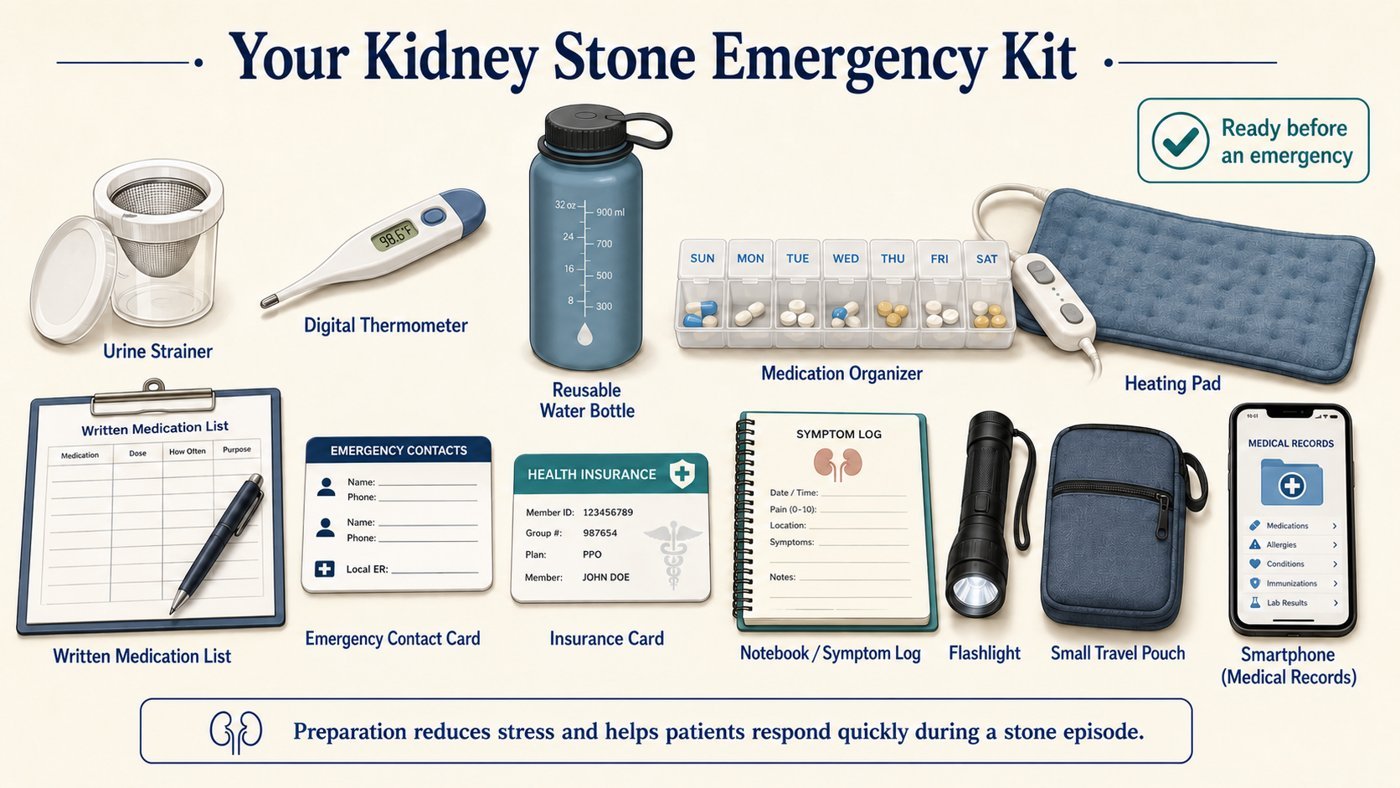
Your Kidney Stone Emergency Kit
The objective is not to prove that the pain is a stone. The objective is to identify any feature that makes home observation unsafe. A prior history of stones increases the likelihood that a similar episode is another stone, but it does not exclude infection, appendicitis, gallbladder disease, vascular emergencies, gynecologic conditions, or other causes of flank and abdominal pain.
If your clinician has prescribed medications for a known stone episode, take them only according to the written instructions and only if they remain safe for your current medical condition. Medication safety can change after a new diagnosis, pregnancy, kidney injury, gastrointestinal bleeding, anticoagulation, dehydration, allergy, or the addition of another drug. A previous prescription is not automatically a permanent standing order.
The First Hour
During the first hour, track four variables: pain control, temperature, vomiting, and urine output. These four variables are more useful than trying to judge the danger of the episode from pain intensity alone. A small uncomplicated ureteral stone can cause extraordinary pain. Conversely, an infected obstructed kidney can initially present with pain that appears manageable.
Use measured, tolerable fluid intake. The goal is to avoid dehydration, not to force several liters of water through a potentially obstructed system. Small, regular amounts are usually easier to tolerate than large boluses, especially when nausea is present. If every sip is immediately vomited, home management is failing because oral medication and hydration cannot be maintained.
Urinate through a clean stone strainer whenever practical. If a stone or fragment is captured, allow it to dry and place it in a clean labeled container. Do not discard it because it looks too small to matter. Stone composition can change the prevention strategy.
The Home Observation Boundary
Home observation is most appropriate when the diagnosis is reasonably established, the patient is stable, pain and nausea are controlled with an agreed plan, oral fluids can be retained, urine continues to pass, and there are no systemic signs of infection. Observation also requires access to follow-up. A patient several hours from emergency care, traveling internationally, pregnant, immunocompromised, anticoagulated, or dependent on a solitary functioning kidney may need a lower threshold for direct evaluation.
A stable episode still needs a stopping rule. Pain that repeatedly breaks through the treatment plan, persistent vomiting, worsening weakness, new fever, decreasing urine output, fainting, confusion, or inability to function safely are reasons to escalate. So is diagnostic uncertainty. The safest answer to an unclear severe abdominal or flank syndrome is not to keep assuming it is a familiar stone.
Go Directly for Emergency Evaluation
Seek urgent emergency evaluation for fever or rigors with suspected obstruction; inability to urinate or a major decline in output; persistent vomiting with inability to retain fluids or medications; fainting, confusion, severe weakness, chest symptoms, or low blood pressure; severe pain that remains uncontrolled; known solitary functioning kidney with possible obstruction; bilateral obstruction; pregnancy with significant pain or systemic symptoms; transplant kidney symptoms; significant immunosuppression; or any episode in which the diagnosis is uncertain and another emergency is possible.
Visible blood can accompany stones, but heavy bleeding, clots, urinary retention, or bleeding without a clear stone diagnosis also warrants prompt assessment. Patients taking anticoagulants should not assume that blood is simply an expected medication effect.
What to Bring to the Emergency Department
Bring a current medication list, allergies, relevant diagnoses, prior stone analysis, recent imaging reports, a summary of prior procedures, and the name of the treating urologist. Digital access to actual images can be useful, but a written radiology report is still better than arriving with no data. Tell the clinical team whether you have one kidney, chronic kidney disease, pregnancy, a transplant, prior sepsis, resistant organisms, or an indwelling stent.
A concise opening statement improves triage: “I have a history of stones. This episode began at [time]. The pain is on the [side]. My temperature is [number]. I have vomited [number] times. My last normal urination was [time]. I have [one/two] functioning kidneys, and I am taking [relevant medications].” This is more useful than a long account interrupted by pain.
Questions That Clarify the Plan
Ask what the imaging shows, whether the kidney is obstructed, whether infection is suspected, whether kidney function has changed, and whether urgent drainage is needed. If discharge is recommended, ask what medications to take, what side effects matter, how long observation is reasonable, when follow-up imaging is planned, and exactly which symptoms require return.
If a procedure is recommended, ask whether the goal is urgent drainage or definitive stone removal. These are not the same operation. An infected obstructed system is usually drained first; definitive stone treatment is performed after stabilization and infection control.
After the Pain Stops
The disappearance of pain does not always prove that the stone has passed. Pain may improve because the stone moved, because obstruction became partial, because medication worked, or because the kidney temporarily reduced urine production. Confirm passage by capturing the stone, documenting its entry into the bladder, or obtaining follow-up imaging when indicated. Persistent silent obstruction is uncommon but clinically important.
Once the acute episode resolves, preserve the record. Save the radiology report, laboratory results, discharge instructions, procedure note, stone analysis, and medication list. These documents form the beginning of a stone passport that prevents future care from restarting at zero.
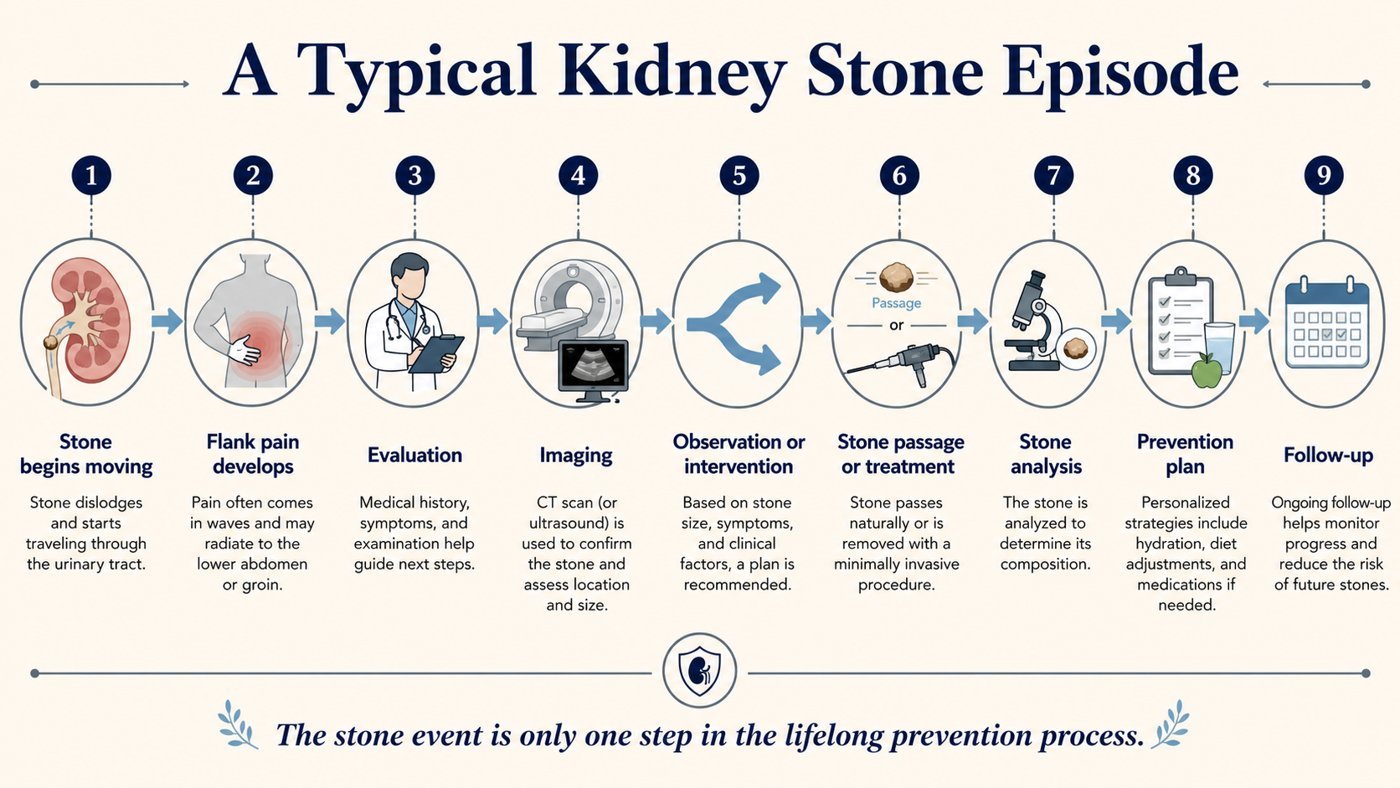
A Typical Kidney Stone Episode
The Stone Survival Kit
A practical home kit includes a thermometer, urine strainers, a clearly labeled medication list, a copy of the individualized action plan, a water bottle with volume markings, a small container for captured stones, emergency contact information, and digital copies of recent imaging and laboratory reports. A heating pad may help some patients with muscular discomfort, but it should never be used to delay evaluation when red flags are present.
The purpose of the survival kit is not self-treatment without medical oversight. It is preparedness. A prepared household recognizes danger earlier, communicates more efficiently, and reduces avoidable panic.