October 2026 English edition · Evidence reviewed through October 3, 2026 · David Shusterman, MD
Appendix Q: The Stone-Free Printable Toolkit
The Stone-Free Protocol works best when information is captured before pain, medication, fear, and fragmented care distort the story. These worksheets convert the book’s major clinical principles into practical records that can travel with you from home to the emergency department, the urologist’s office, the laboratory, and future follow-up visits.
Print the pages you need, keep the emergency materials with your medication list, and store completed records with your imaging reports and stone-analysis results. These tools support communication and organization; they do not replace individualized medical advice. Fever or shaking chills with suspected obstruction, inability to urinate, uncontrolled vomiting, fainting, confusion, severe weakness, pregnancy with significant pain, a solitary functioning kidney with reduced urine output, or rapidly worsening symptoms require prompt professional assessment.
Toolkit 1: One-Page Stone Emergency Card
Patient: ______________________________ Date of birth: __________________
Primary urologist: _____________________ Phone: _________________________
Primary care clinician: ________________ Phone: _________________________
Preferred hospital: ____________________ Emergency contact: ______________
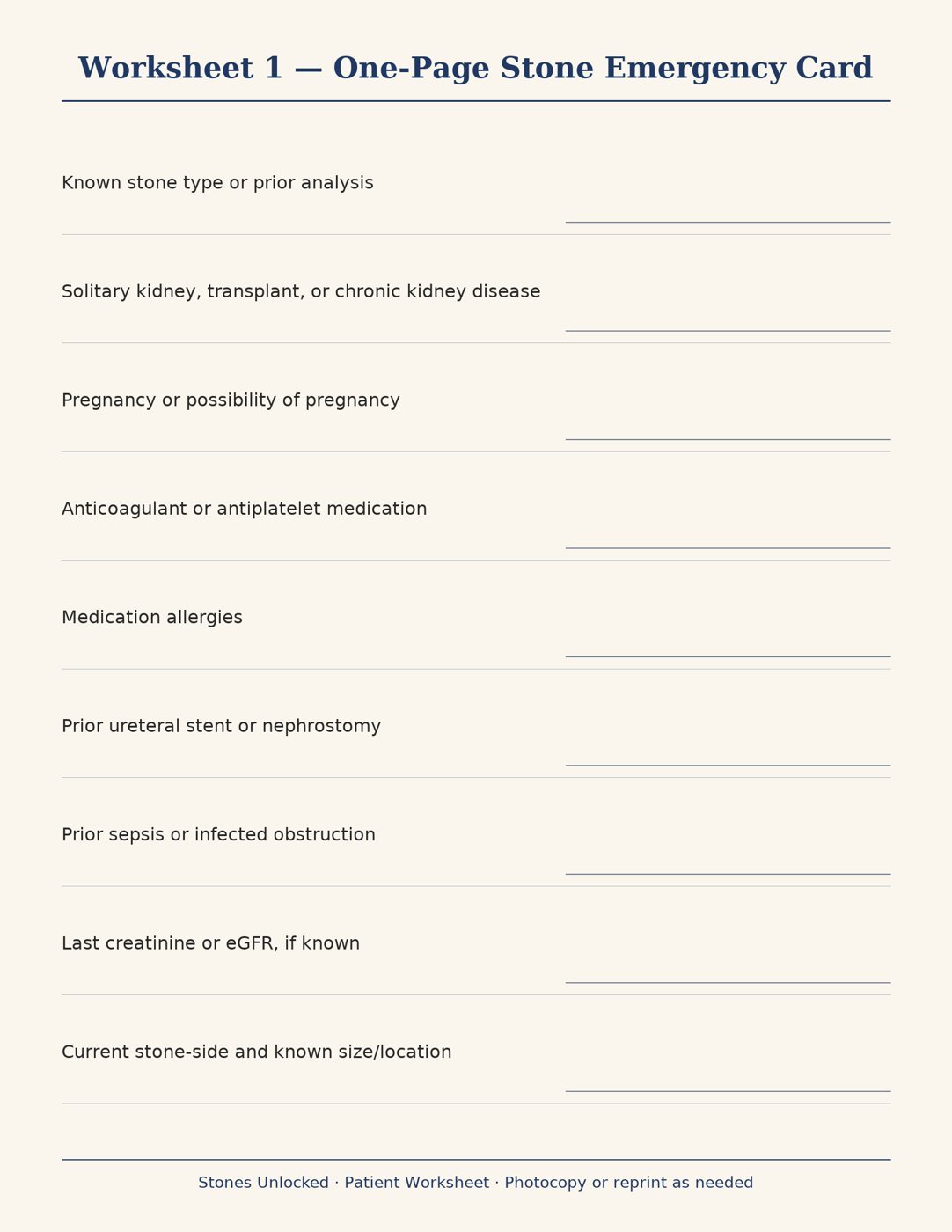
Worksheet 1. One-Page Stone Emergency Card
Go for urgent evaluation when: fever or shaking chills occur with flank pain; urine output becomes absent or markedly reduced; vomiting prevents fluids or medication; pain remains uncontrolled; weakness, confusion, fainting, or low blood pressure develops; symptoms occur in a solitary kidney, during pregnancy, or after a recent urinary procedure; or the clinical picture is changing rapidly.
Toolkit 2: Acute Stone Episode Timeline
Record events as they happen. A clear timeline is often more useful than a general statement that the pain has been present “all day.”
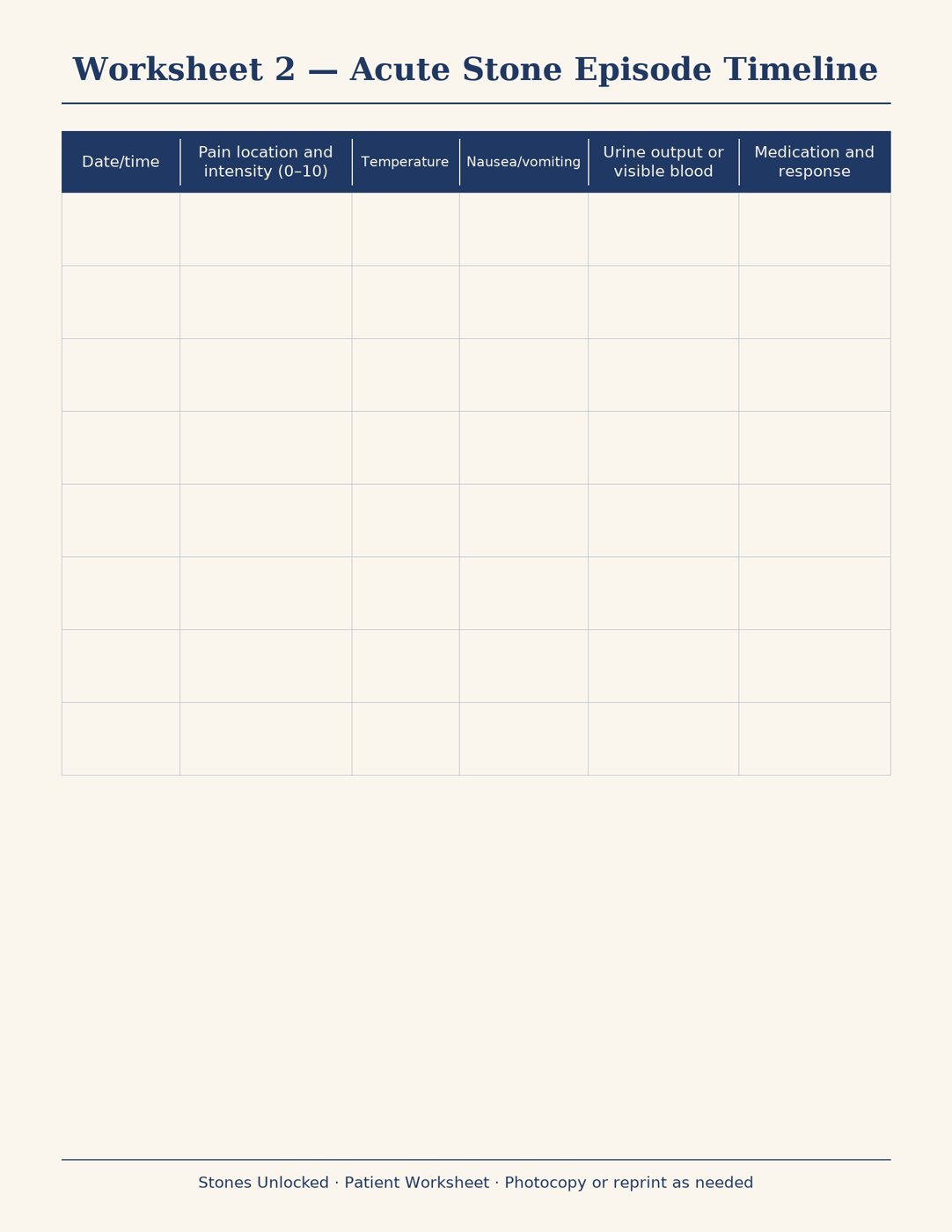
Worksheet 2. Acute Stone Episode Timeline
Pain began: __________________ Sudden or gradual: ______________________
Pain migrated toward groin/bladder: ______________________________________
Last normal urination: ___________________________________________________
Last food and fluid tolerated: ___________________________________________
Other symptoms: _________________________________________________________
Toolkit 3: Home Safety Monitoring Log
Use this only when a clinician has determined that home observation is appropriate. A log is not permission to remain home when red flags develop.
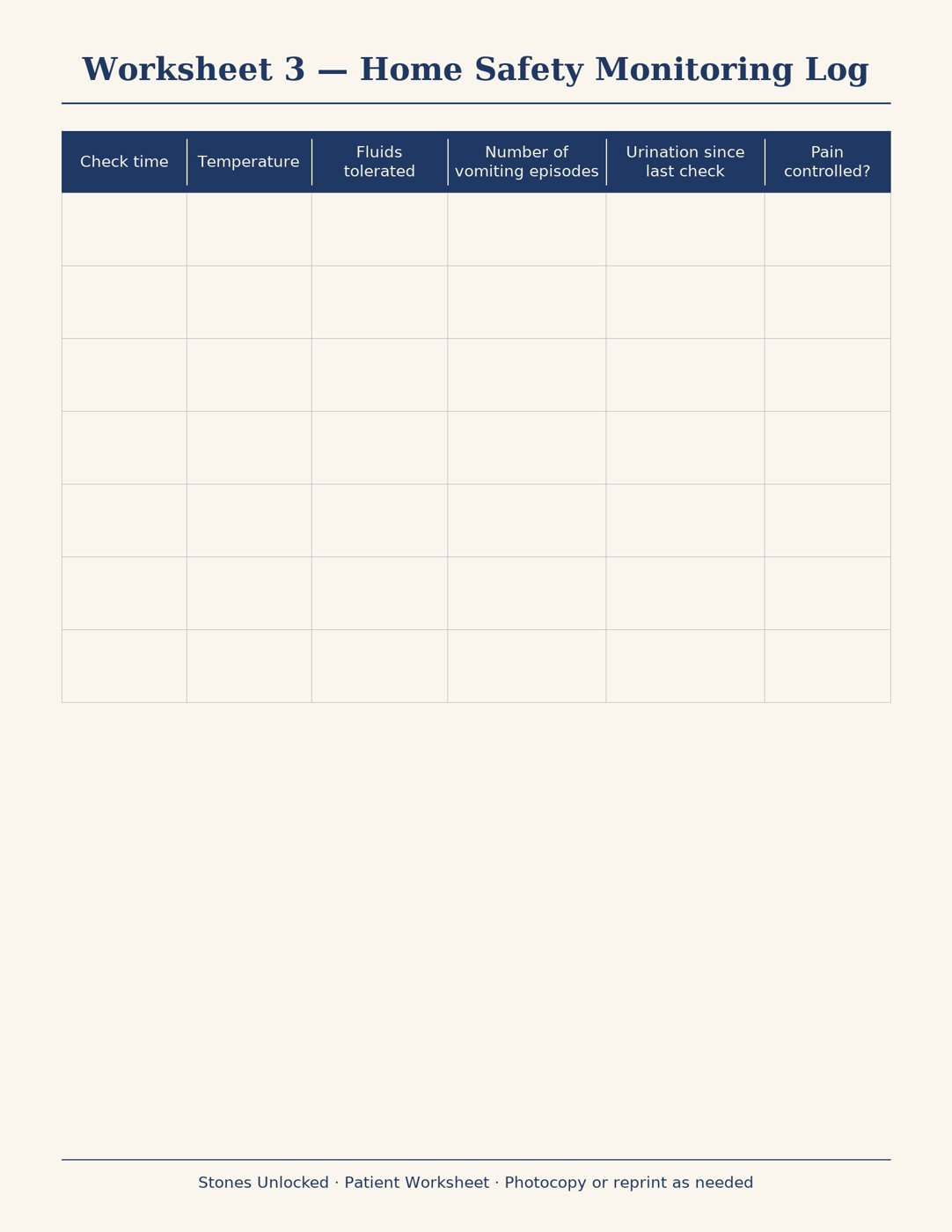
Worksheet 3. Home Safety Monitoring Log
Call placed to clinician at: __________________ Advice received: __________
Planned reassessment or imaging date: ____________________________________
Toolkit 4: Medication and Safety Record
Do not start, stop, double, or combine prescription medication solely from this worksheet. Use it to prevent missed doses, duplicate dosing, and incomplete histories.
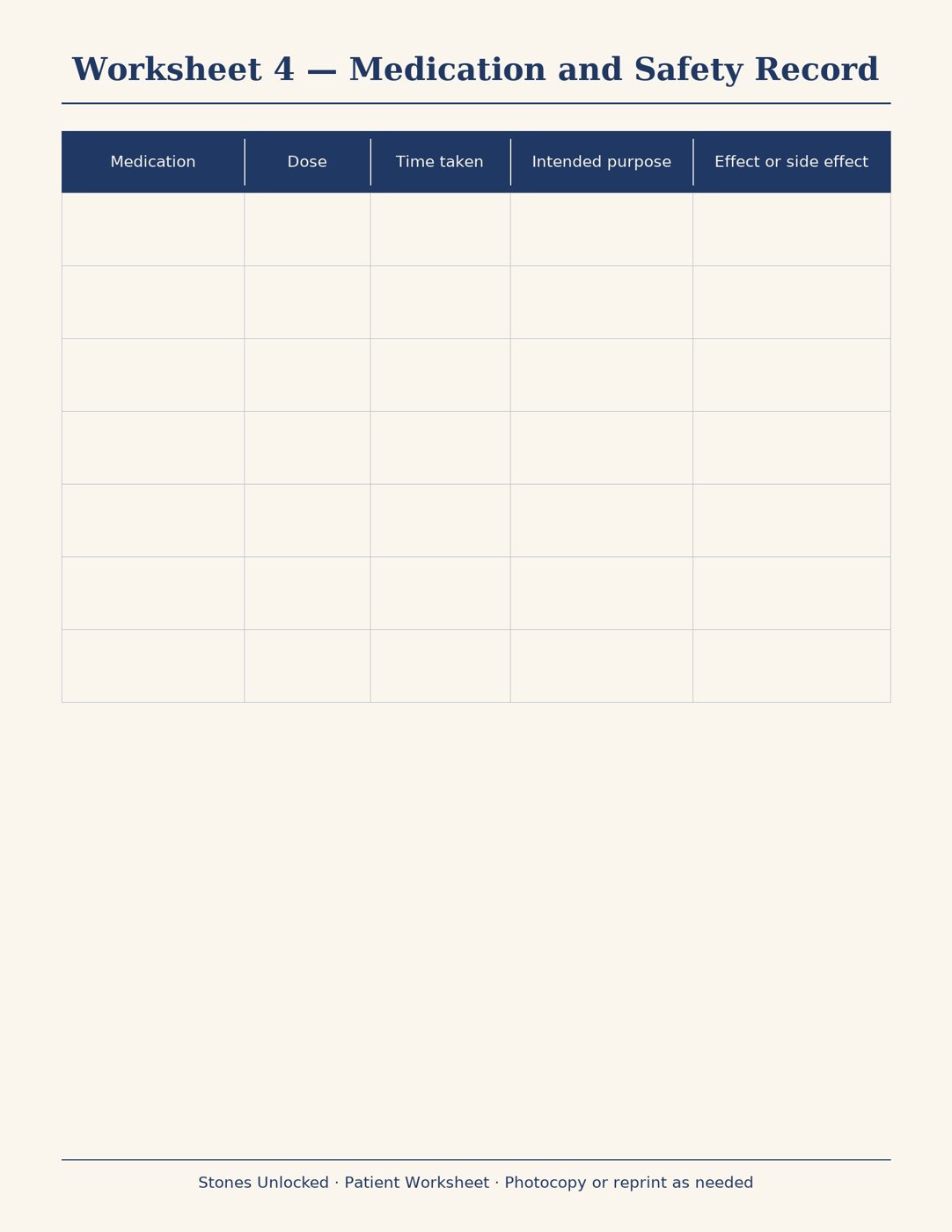
Worksheet 4. Medication and Safety Record
NSAID precautions discussed: kidney disease / ulcer or bleeding history / anticoagulation / allergy / pregnancy / cardiovascular risk / other: __________________
Alpha-blocker precautions discussed: dizziness / low blood pressure / fall risk / ejaculatory effects / other: __________________
Pharmacy: __________________________ Phone: ___________________________
Toolkit 5: Daily Hydration and Urine-Output Tracker
The prevention target is generally defined by urine produced, not by a universal number of bottles consumed. Fluid needs vary with body size, climate, exercise, occupation, pregnancy, heart or kidney disease, and other medical conditions.
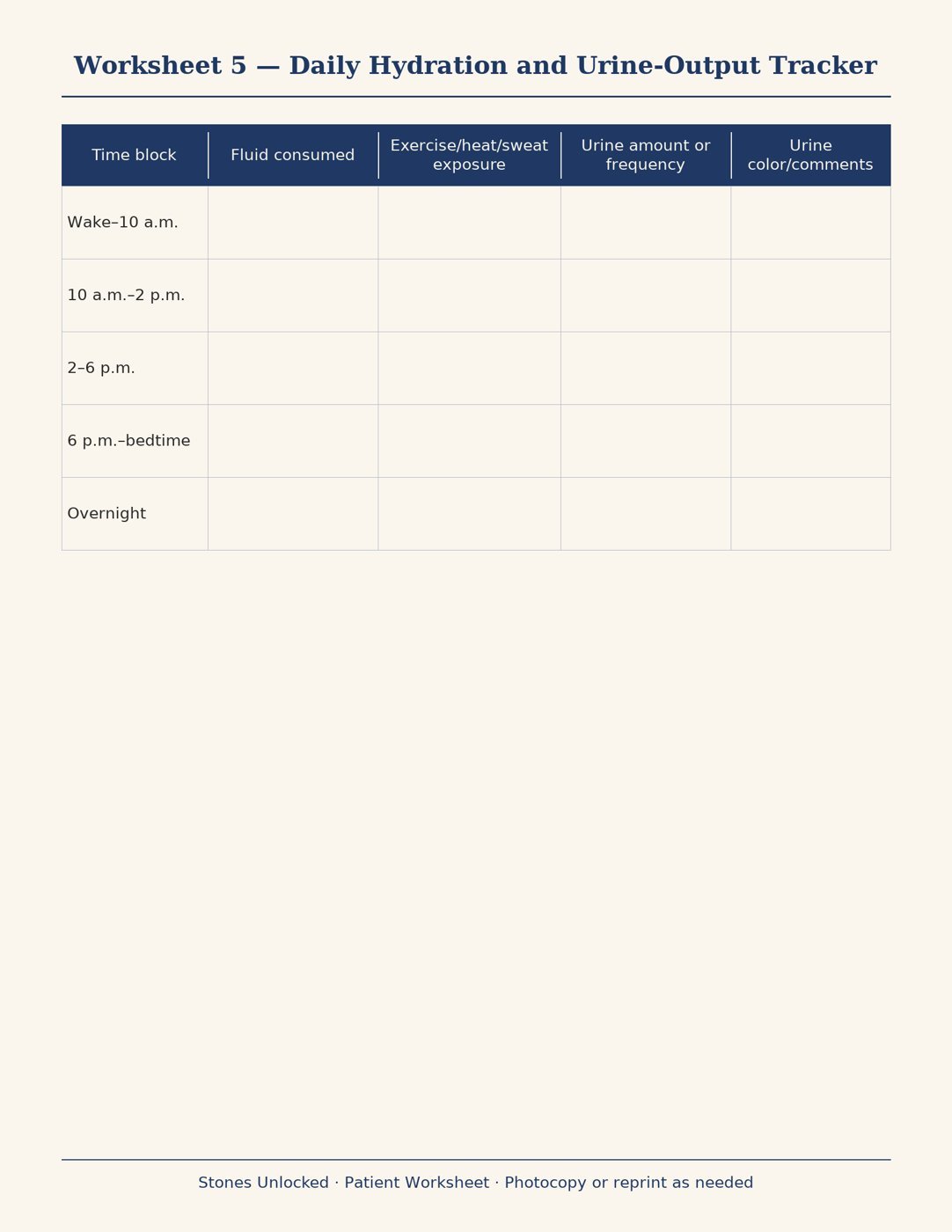
Worksheet 5. Daily Hydration and Urine-Output Tracker
Total fluid: __________________ Measured urine total, if requested: ______
Barriers today: meetings / restricted bathroom access / nausea / travel / fasting / forgot bottle / other: __________________
Plan for tomorrow: _______________________________________________________
Toolkit 6: Sodium and Packaged-Food Audit
Sodium exposure is often hidden in restaurant food, sauces, deli products, soups, breads, frozen meals, and packaged snacks. Record the label serving size as well as the amount actually eaten.
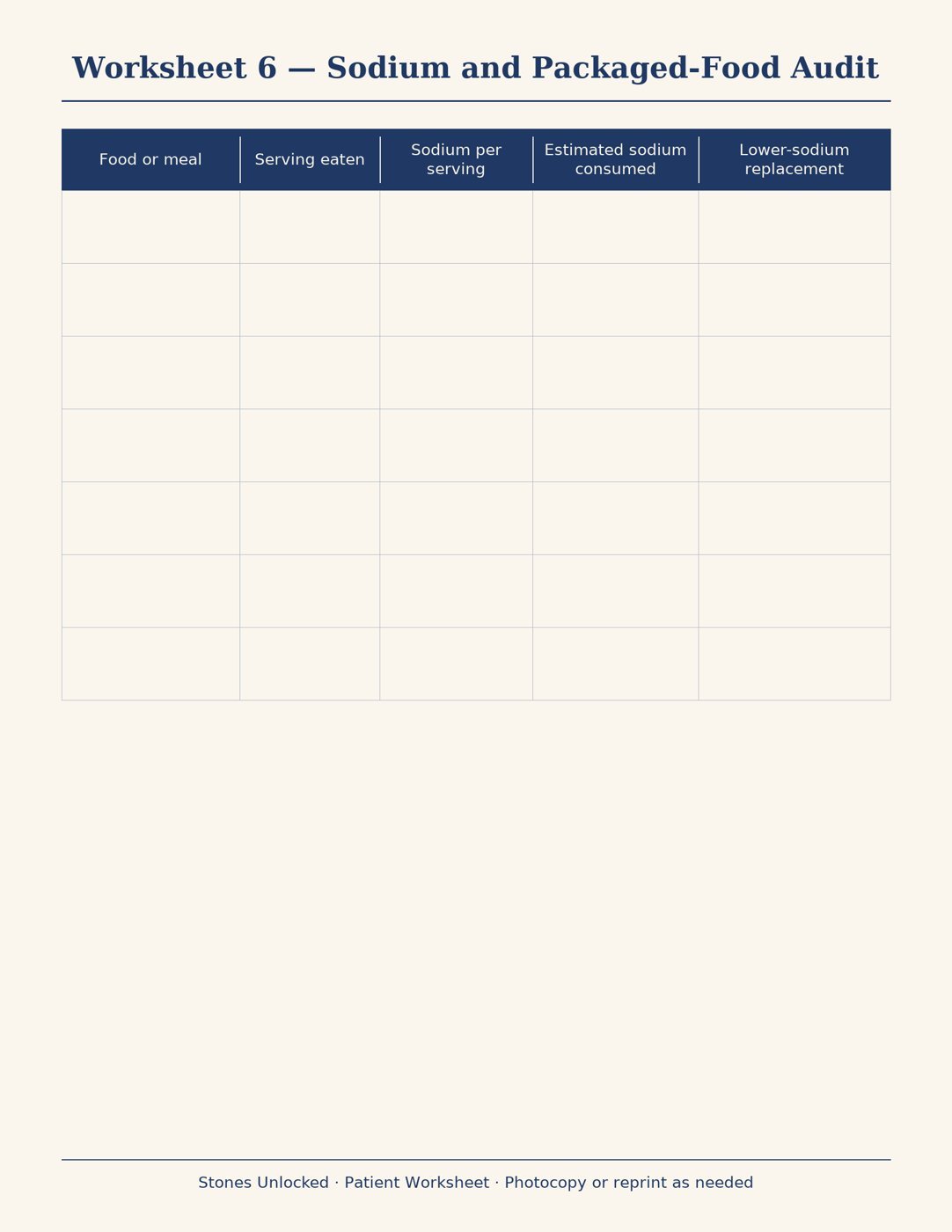
Worksheet 6. Sodium and Packaged-Food Audit
Highest-sodium item today: _______________________________________________
One change that would reduce the total without making the diet unrealistic: ______________________________________________________________________________
Toolkit 7: Calcium–Oxalate Meal-Pairing Planner
This worksheet is intended primarily for calcium oxalate stone formers whose evaluation supports attention to urinary oxalate. It is not a universal instruction to add dairy or supplements to every meal.
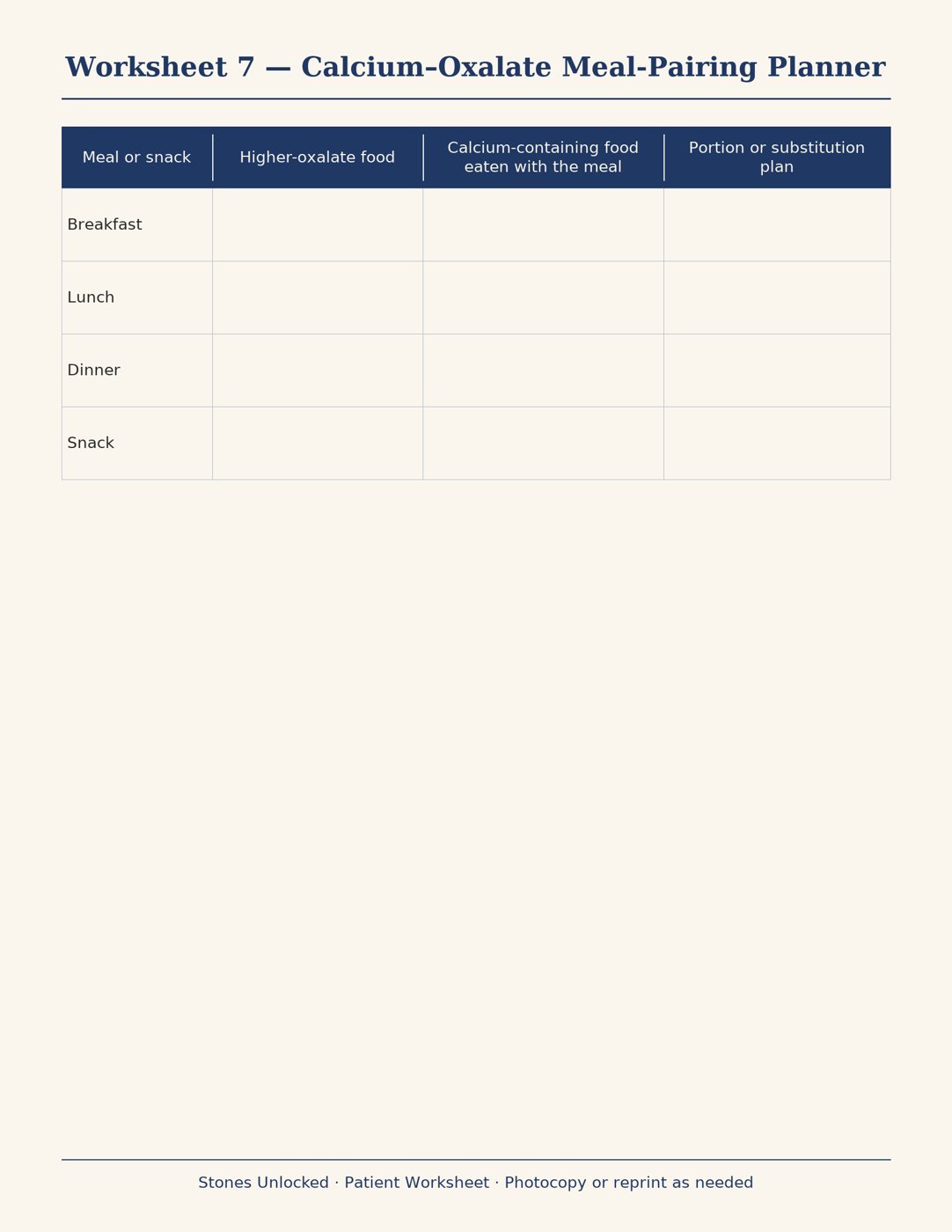
Worksheet 7. Calcium–Oxalate Meal-Pairing Planner
Foods that repeatedly create difficulty: __________________________________
Dietitian or clinician guidance: __________________________________________
Toolkit 8: Stone Specimen and Laboratory Record
A passed or surgically removed stone is a diagnostic specimen. Allow it to dry as instructed, place it in the supplied clean container, and submit it according to the laboratory or urology office protocol.
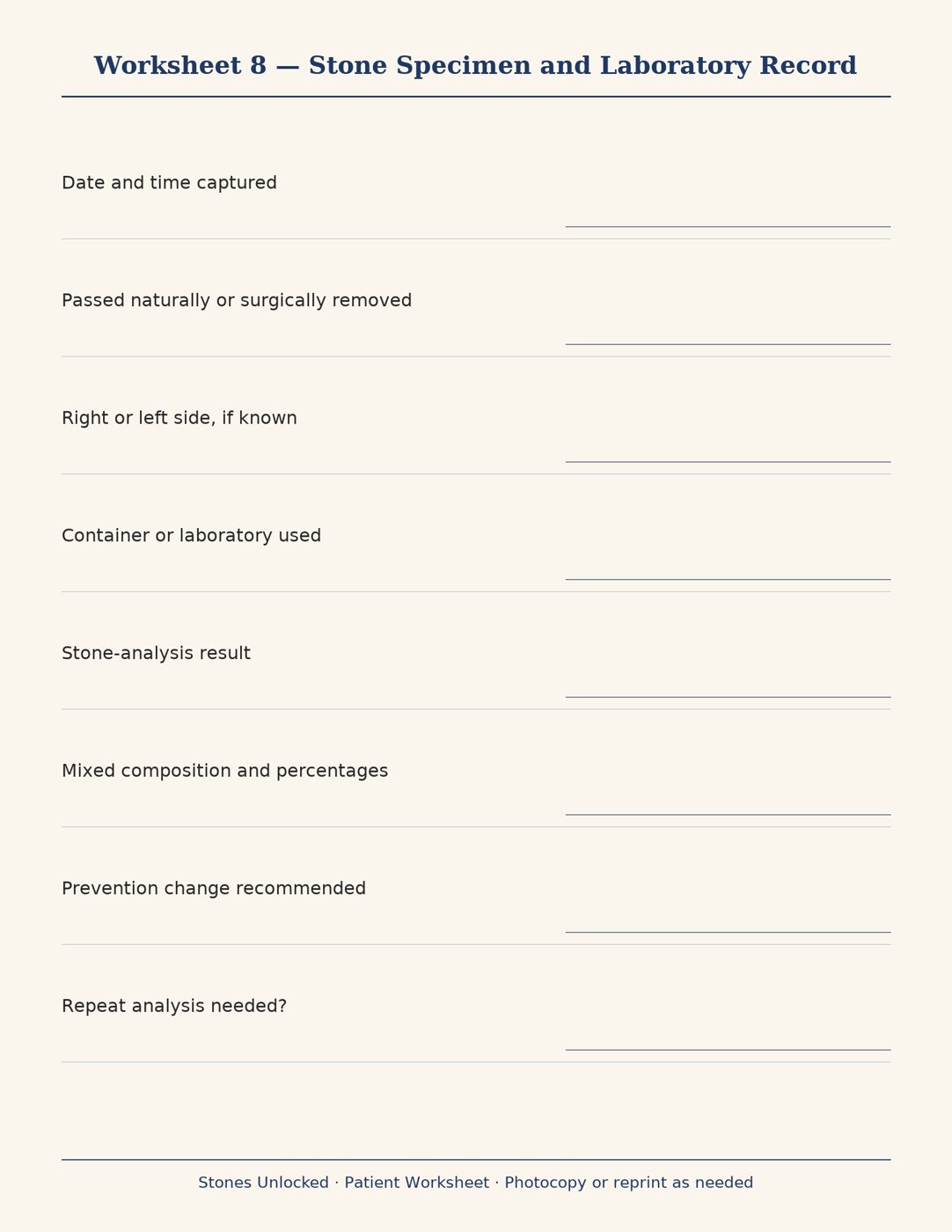
Worksheet 8. Stone Specimen and Laboratory Record
Photo taken before submission: yes / no
Report stored with medical records: yes / no
Toolkit 9: Imaging and Radiation History
Keeping a portable imaging history helps avoid unnecessary duplication and allows clinicians to compare change over time.
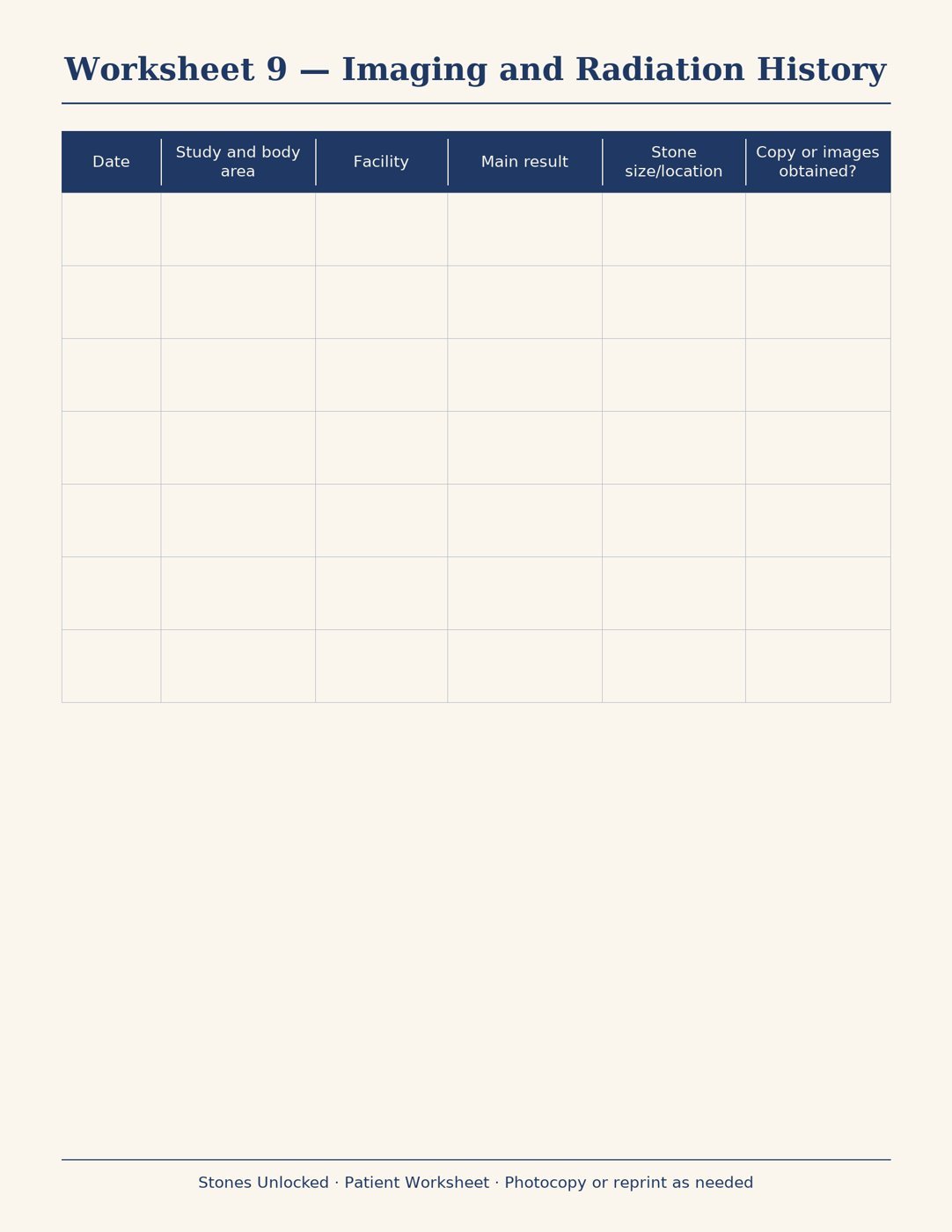
Worksheet 9. Imaging and Radiation History
Prior CT images available electronically or on disc: _______________________
Pregnancy status communicated before imaging: yes / no / not applicable
Question for next visit: Can ultrasound, KUB, or reduced-dose CT answer the follow-up question?
Toolkit 10: 24-Hour Urine Comparison Worksheet
Compare trends rather than focusing on one isolated number. Laboratory reference ranges and treatment targets differ by laboratory, stone type, body size, kidney function, and clinical context.
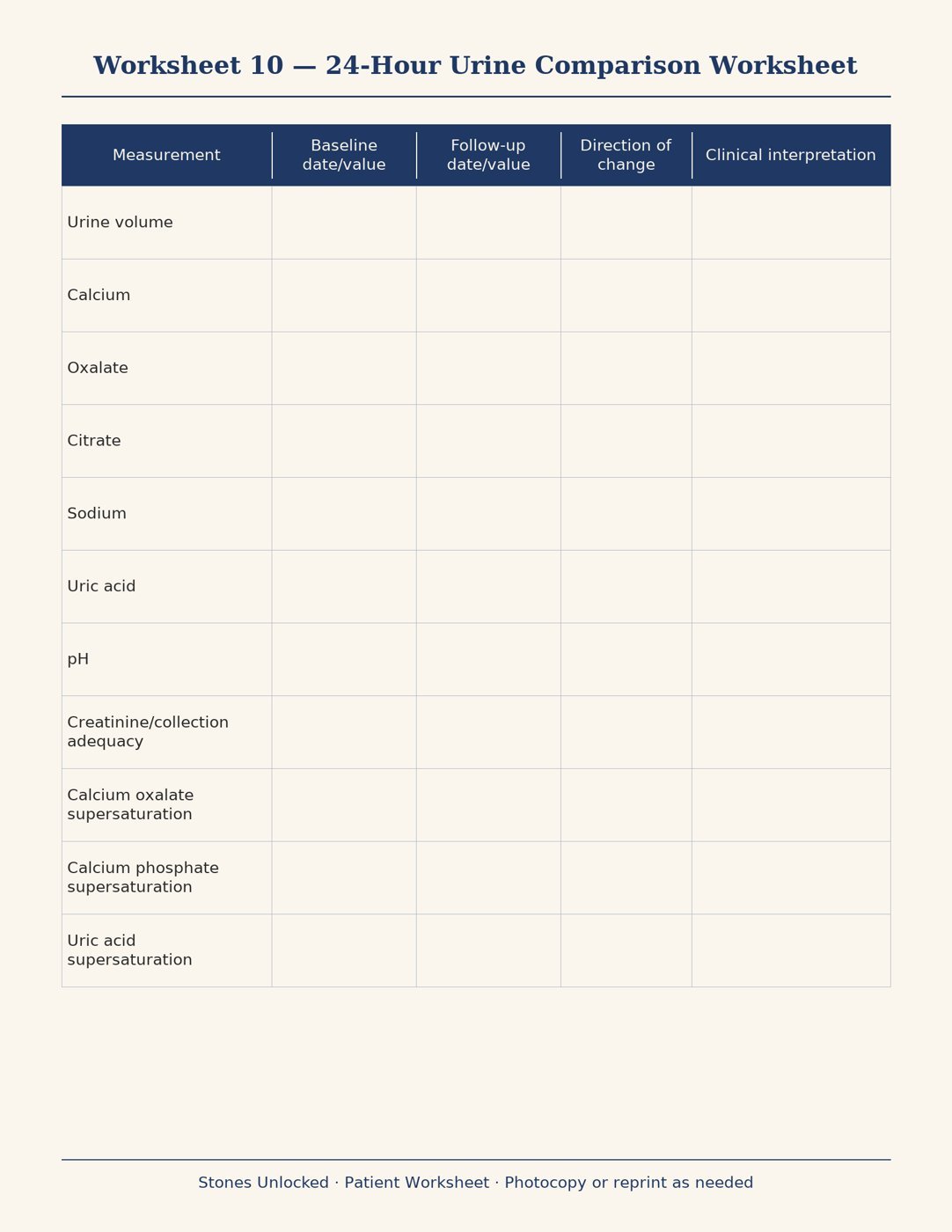
Worksheet 10. 24-Hour Urine Comparison Worksheet
Intervention between collections: _________________________________________
Was the collection performed on a representative day? ____________________
Next test date: ___________________________________________________________
Toolkit 11: Annual Stone-Free Maintenance Checklist
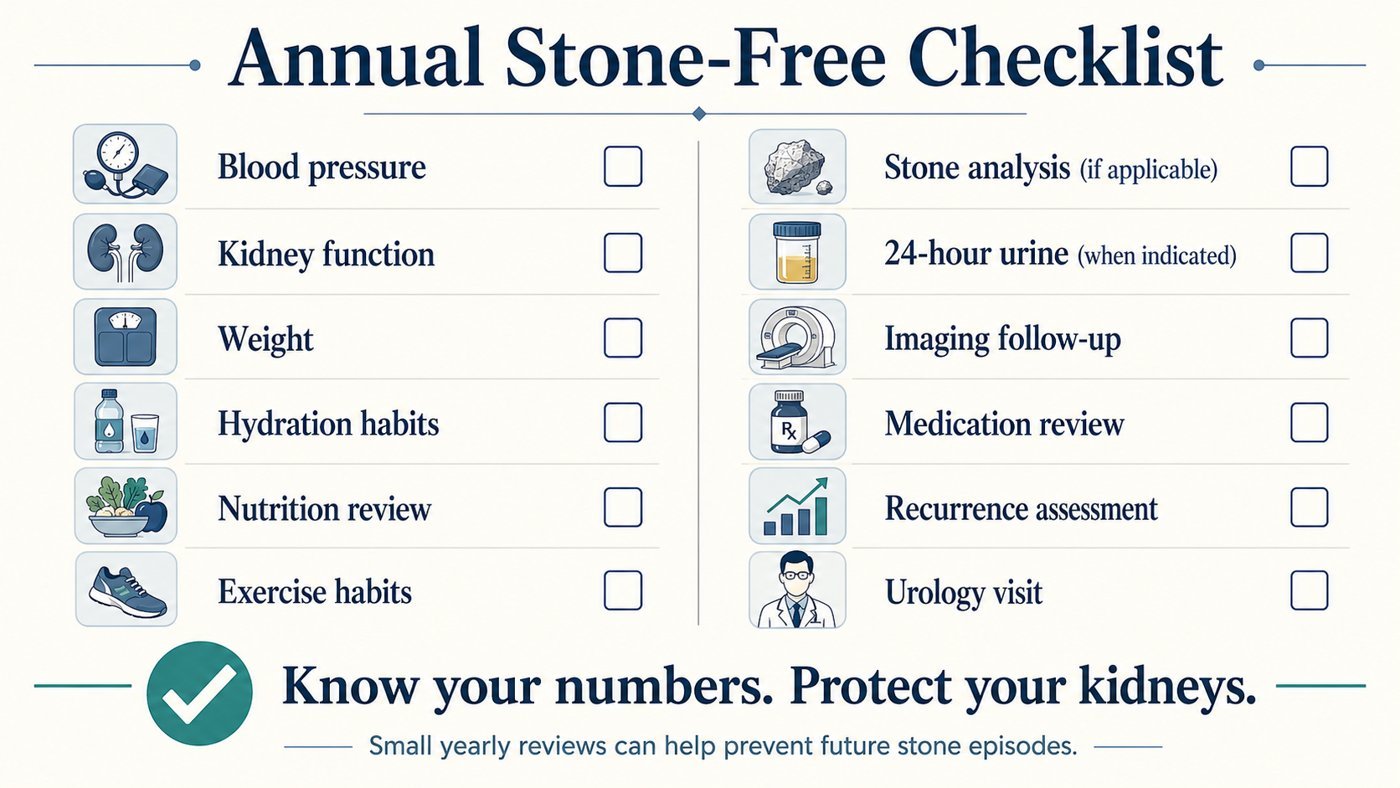
Annual Stone-Free Checklist
This is an individualized planning framework, not a universal testing schedule.
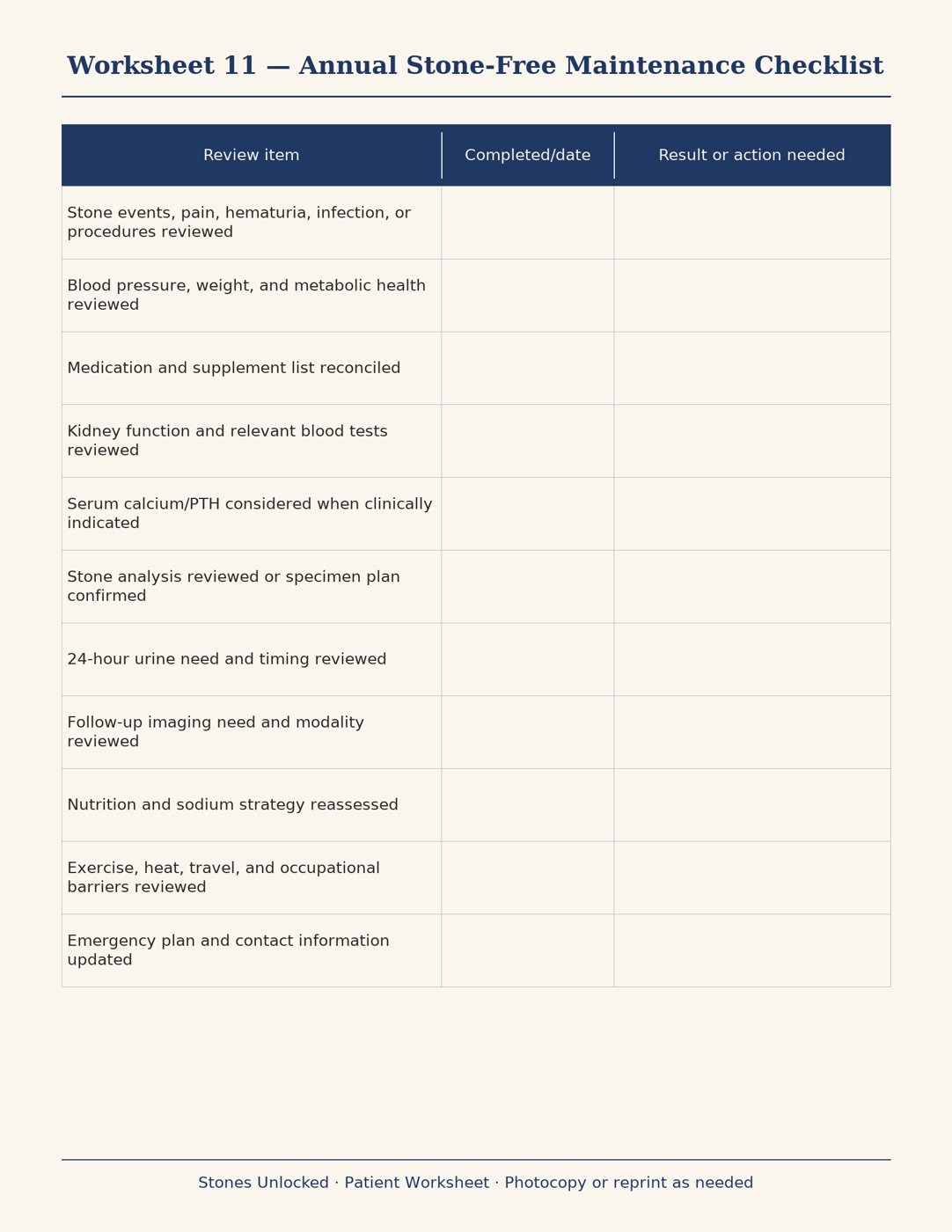
Worksheet 11. Annual Stone-Free Maintenance Checklist
Primary goal for the next year: ___________________________________________
Next appointment: __________________ Next laboratory/imaging date: _____
Toolkit 12: Travel and Long-Flight Checklist
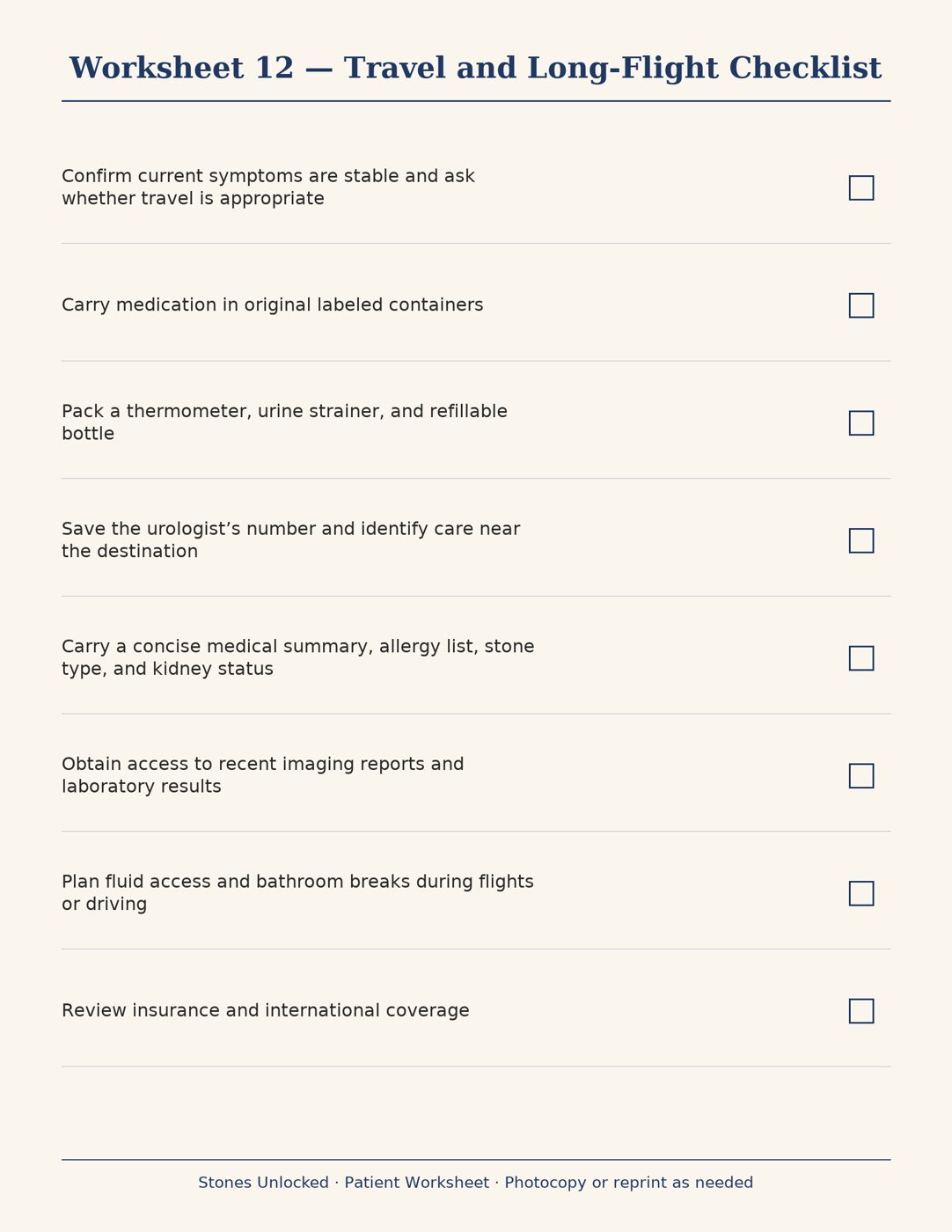
Worksheet 12. Travel and Long-Flight Checklist
Destination medical facility: _____________________________________________
Flight or travel duration: __________________ Hydration plan: __________
Heat, altitude, endurance activity, fasting, or alcohol exposure anticipated: ______________________________________________________________________________
Toolkit 13: Questions for the Urologist
Bring the questions relevant to your situation rather than trying to ask all of them at once.
What is the stone’s size, exact location, and degree of obstruction?
Is there evidence of infection, kidney injury, or another emergency?
What is the realistic chance of spontaneous passage in my case?
What is the observation plan, and what are the stopping rules?
Would an alpha-blocker be useful for this stone?
Which pain medicines are safest given my kidney function and other medications?
How and when will we confirm passage?
If intervention is needed, why is ureteroscopy, SWL, or PCNL the best fit?
Is a stent necessary, optional, or unlikely, and how long would it remain?
Was my stone analyzed, and what did the composition show?
Do I need blood testing or one or two 24-hour urine collections?
Which nutrition changes are supported by my results rather than by generic advice?
How will we measure whether diet or medication is working?
What imaging should be used for surveillance while minimizing unnecessary radiation?
What symptoms should send me directly to emergency care?
Toolkit 14: Portable Stone Medical Summary
Diagnosis and stone type: _________________________________________________
First stone/year: __________________ Most recent stone/year: ___________
Number of symptomatic episodes: ______ Number of procedures: __________
Known stone composition: __________________________________________________
Highest-risk metabolic findings: __________________________________________
Current prevention medications: ___________________________________________
Relevant conditions: solitary kidney / CKD / pregnancy / bowel disease / bariatric surgery / gout / hyperparathyroidism / recurrent UTI / cystinuria / other: __________________
Prior procedures and stent tolerance: ______________________________________
Latest imaging summary: ___________________________________________________
Latest 24-hour urine summary: _____________________________________________
Emergency contact and urologist: __________________________________________
Patient priorities or prior complications: _________________________________
Keep this summary current. A concise, accurate record improves continuity when care occurs outside your usual health system.
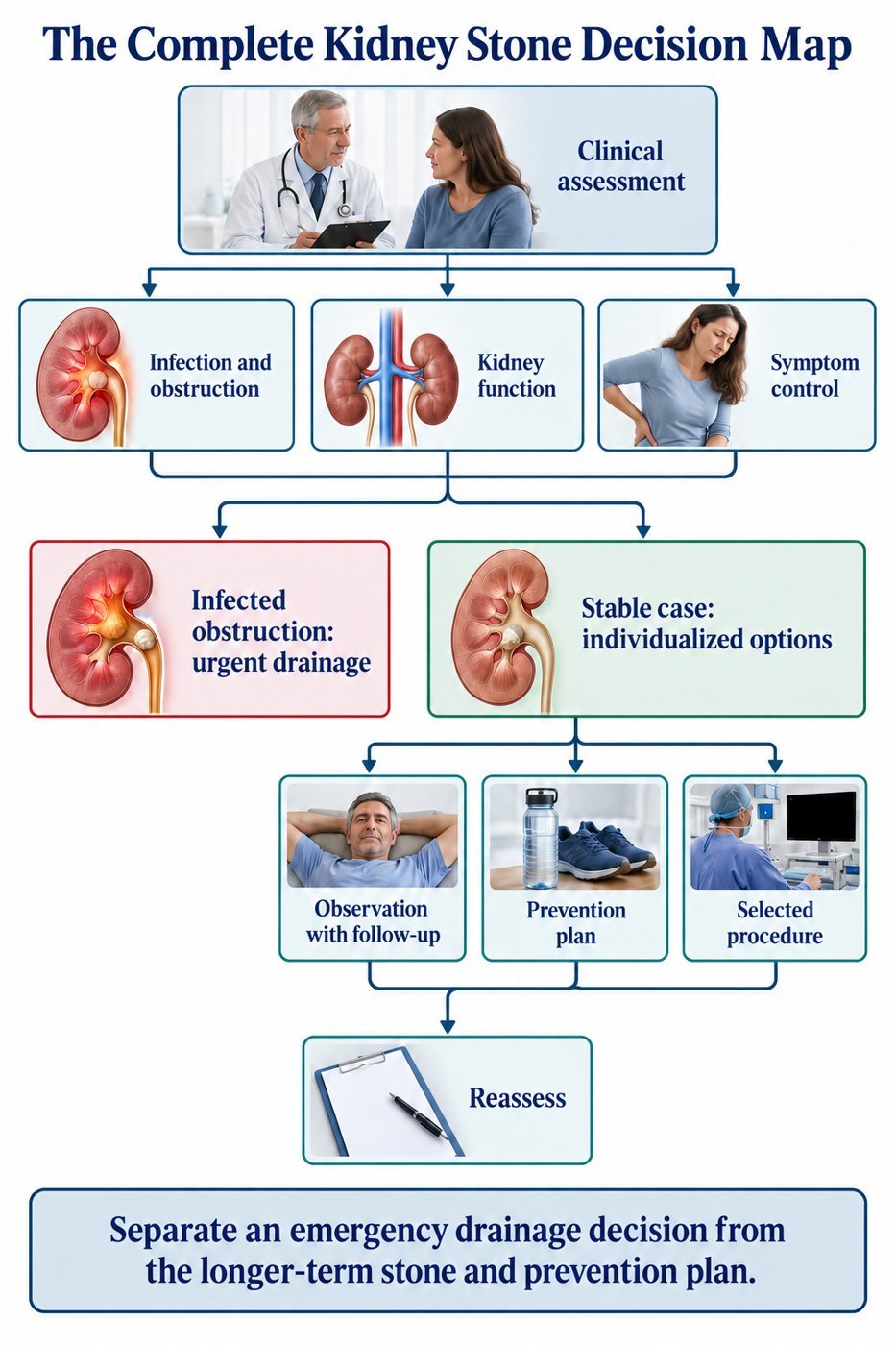
The Complete Kidney Stone Decision Map
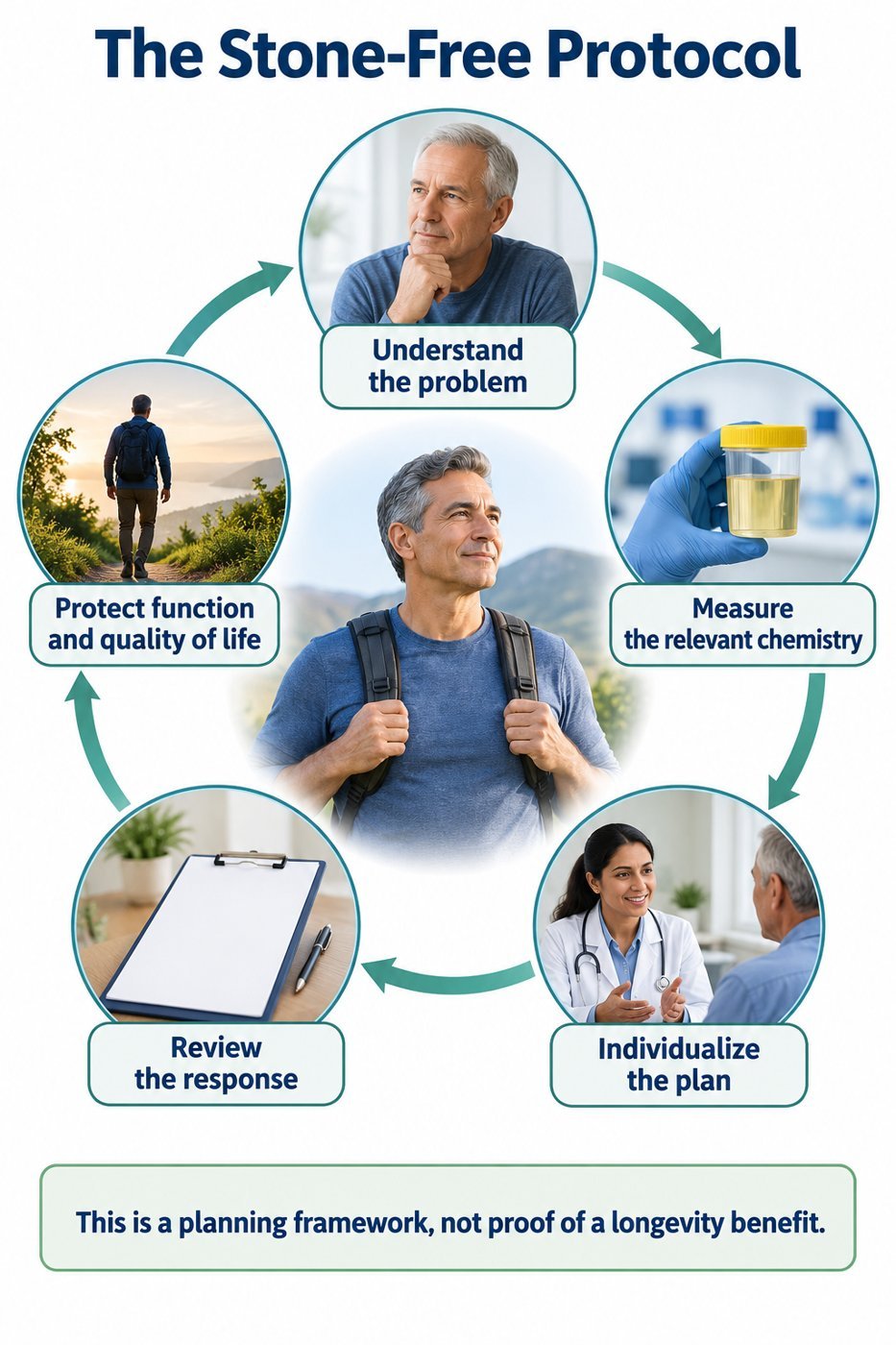
The Stone-Free Protocol
You have reached the end of the working apparatus of this book — but not the end of the work. The protocols, checklists, and worksheets in these pages only pay off when they are used: copied, filled in, carried to appointments, and revised as your numbers change. Start with the ones that match where you are today. The rest will wait for you.