
Longevity & Evidence
How to Evaluate Longevity Treatment Claims
Use the evidence ladder to distinguish laboratory findings, early human studies and stronger clinical evidence before discussing a longevity treatment.
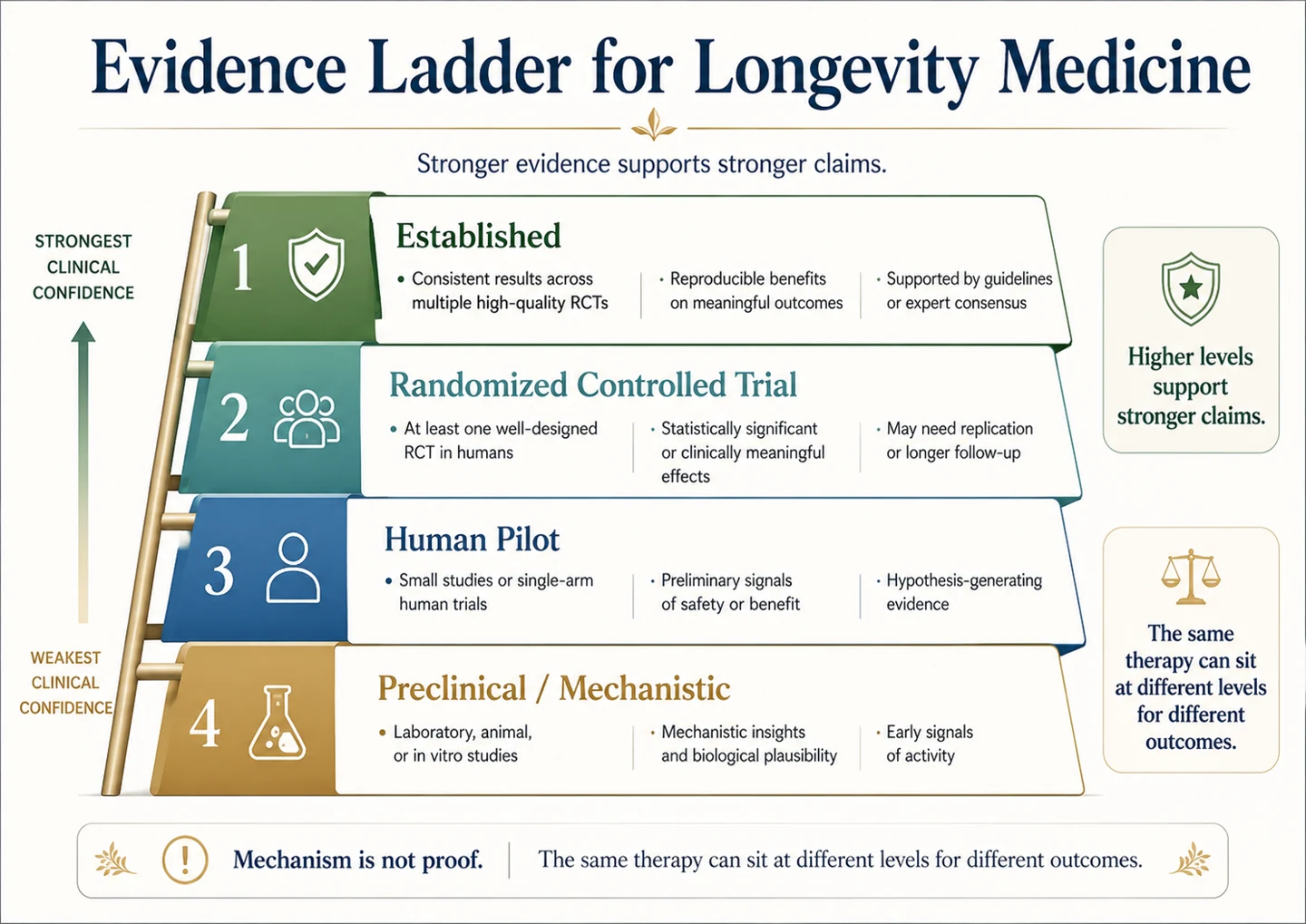
A promising mechanism is the beginning of a question
A longevity headline may describe a laboratory finding, a small human study, or an established clinical benefit. Those are different kinds of information. The evidence ladder in UroLongevity gives readers a way to keep them separate before deciding what a claim means.
Text explanation of the four levels
- Preclinical or mechanistic: laboratory or animal research offers a possible explanation to investigate. It does not establish that a treatment improves human health.
- Human pilot: early studies can identify questions about feasibility, safety, or potential benefit. Small or uncontrolled studies leave substantial uncertainty.
- Randomized controlled trial: a comparison designed to test an intervention in people. Results still depend on study quality, the participants, the chosen outcome, and follow-up.
- Established clinical evidence: confidence grows when meaningful findings are reproduced and considered alongside the broader evidence.
NIH describes randomized controlled trials as a central method for testing whether treatments work. Observational research can help identify patterns and generate questions, but an association alone does not establish cause and effect.1
Ask what actually improved
The figure’s most useful reminder is that one therapy may have different evidence for different outcomes. A claim about a laboratory measure should not quietly become a claim about independence, fewer hospitalizations, or longer life.
For example, consider a hypothetical headline saying that an intervention “improved an aging marker.” Before interpreting it as proof of longer life, ask what was measured, whether there was a comparison group, how long people were followed, and whether outcomes that matter to patients changed. This is an example of how to read a claim, not a judgment about a particular product.
Five questions worth bringing to the visit
- What is the exact goal? Name the symptom, function, or health outcome you hope to improve.
- Who was studied? Ask whether participants resemble you in age, health, and other treatments.
- What was the comparison? Improvement over time alone can be hard to interpret.
- What remains uncertain? Include harms, duration of benefit, and unanswered long-term questions.
- How will we decide whether to continue? Agree on follow-up, measurable goals, and reasons to stop.
A figure cannot choose a treatment for you. It can help you and your clinician agree on which claims are supported, which are preliminary, and which questions still need an answer.
1 Research background: NIH, Understanding Clinical Studies.
Sources and further reading
Explore UroLongevity
Continue with the book and use this guide to prepare questions for your clinician.
View book and editions →For general education. This guide does not provide a diagnosis or replace individual medical advice. Discuss testing and treatment decisions with your clinician.